
Markets in October 2026: Tech Turbulence, High Yields, and What Comes Next
October 2026 looked like a solid month for stocks until the final four days changed the tone entirely. A sharp technology sell-off erased most of the S&P 500's earlier gains, leaving the index roughly flat for the month and investors with two pressing questions: how much further will bond yields climb, and is another Fed rate hike coming in December? Here is what happened, and what we are watching heading into November.
Equities: A Month of Two Halves
The S&P 500 entered October near its year-to-date high and held those levels through most of the month. Then the final trading week arrived, and disappointing earnings from large technology names changed everything quickly.
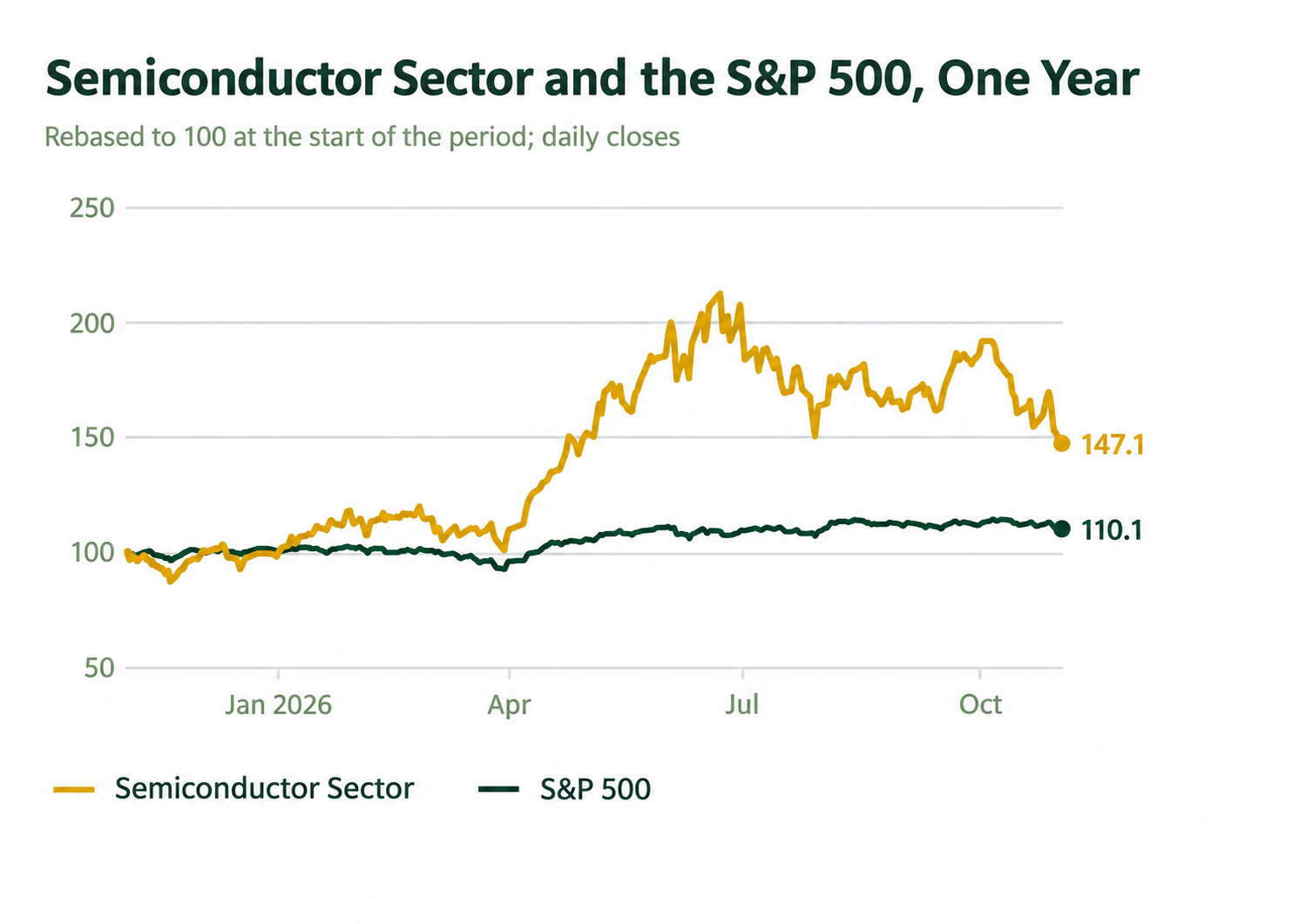
On October 29, Alphabet reported results that reignited concerns about the cost of artificial intelligence buildout. The Nasdaq Composite fell approximately 1.4% that day, while the S&P 500 and Dow each declined about 0.3%. The selling accelerated into Friday, October 30. The Nasdaq dropped 2.86%, finishing at 25,437, and the S&P 500 shed 1.82% to close at 7,580. Intel's warning that it would burn through cash this year, combined with heavy AI capital spending, sent its shares down nearly 29% in a single session and pulled the broader semiconductor sector sharply lower.
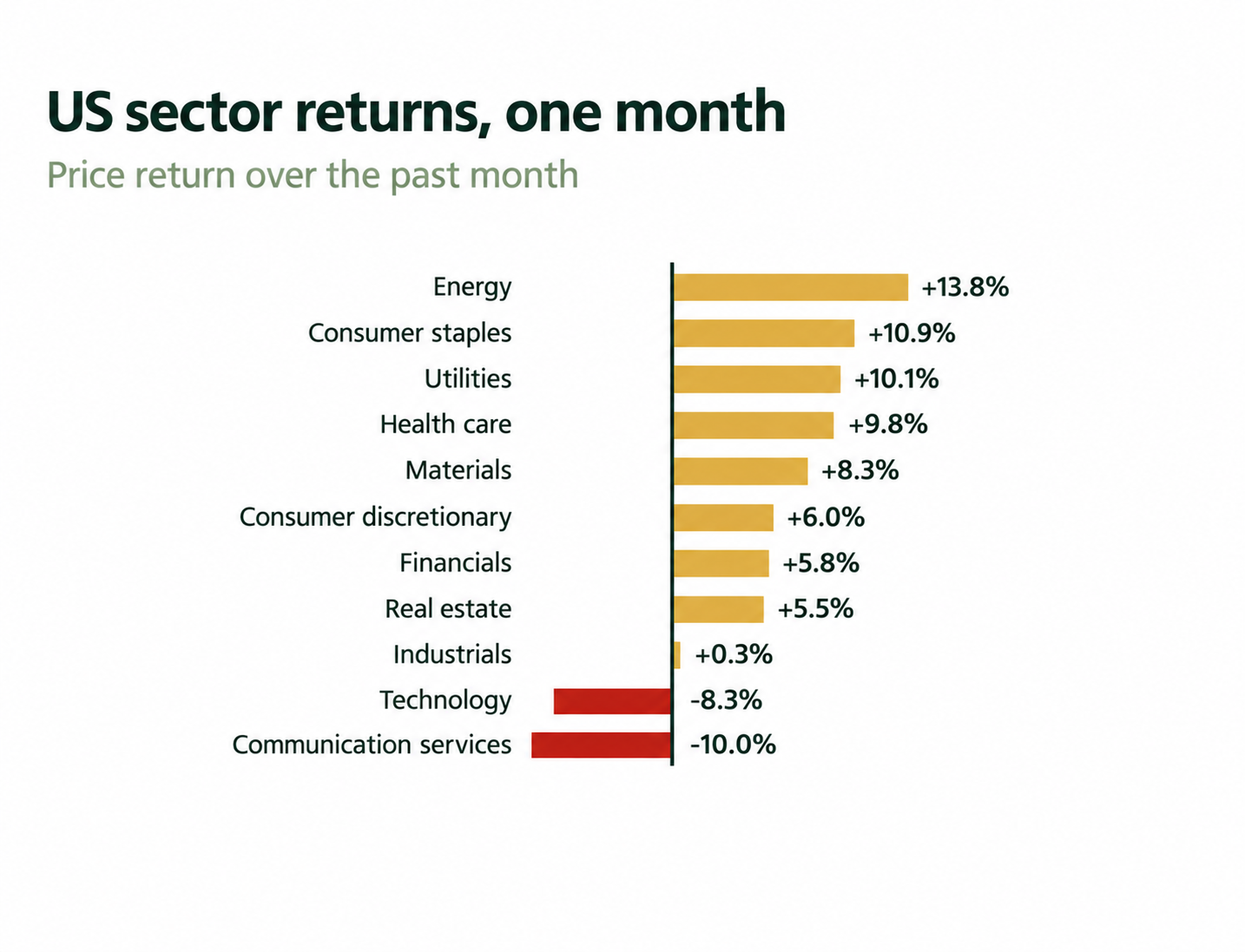
Despite the rough finish, the picture for the broader market was more balanced than the headlines suggested. Nine of the eleven S&P 500 sectors posted monthly gains in October, with Energy up 11.7%, Utilities up 8.6%, and Health Care up 7.8%. The month's pain was concentrated in Technology (down 3.0%) and Communication Services (down 9.2%). The S&P 500 is up approximately 13.7% year to date on a total-return basis through October 29, 2026, roughly the 14th-best start to a year in the past three decades. One uncomfortable week did not erase that full-year progress.
October's semiconductor sell-off is a useful reminder that narrow market leadership amplifies volatility in both directions, and that a diversified portfolio's job is to absorb exactly that kind of concentration risk.
Bond Market: Yields Pull Back From Multi-Year Highs
Bond markets delivered a genuinely notable development in October: yields actually retreated from the extremes hit at the start of the month. The 10-year Treasury had reached 5.31% on October 5, 2026, its highest reading in recent years. By month's end, the picture had shifted. The 10-year Treasury yield eased to 4.91% on October 30, 2026, falling 0.33 percentage points over the course of the month. The 30-year Treasury bond yield stood at 5.32% as of October 29.
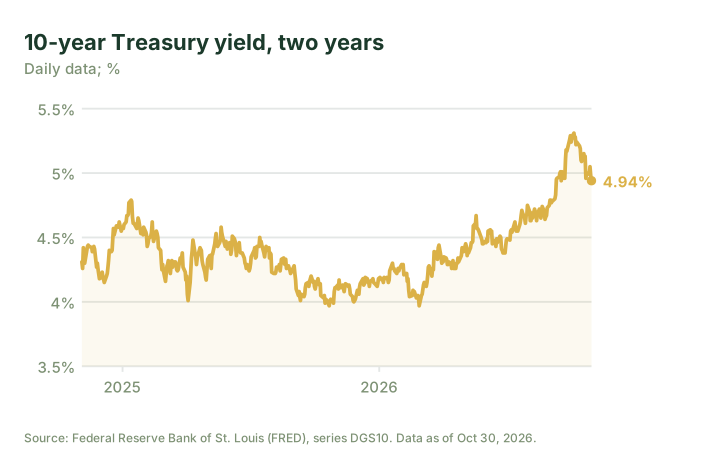
The 10-year Treasury yield's rise to multi-year highs and subsequent pullback illustrate the bond market tension the article describes.
That pullback in yields means bond prices recovered some ground in October after a brutal stretch. Still, the longer-run picture keeps rates elevated. Anyone who owns intermediate or long-duration bonds in a portfolio has felt this cycle acutely.
One data point worth tracking: the 10-year note auctioned on October 7, 2026 carried a high yield of 5.300%, reflecting just how much the market demanded in compensation at that point in the month. The subsequent rally in Treasury prices (and drop in yields) into month-end suggests some buyers stepped in at those levels. That said, yields remain historically elevated, and the direction from here depends heavily on what the Fed signals next.
For clients who are in or approaching retirement, the rate environment carries real implications. Short-term Treasuries and money market instruments are still yielding meaningfully (the 12-month Treasury bill yielded 4.42% as of October 29), which makes the tradeoff between cash and longer bonds worth reviewing carefully before year-end.
The Federal Reserve: On Hold, but Divided
The October 28 FOMC meeting was the month's biggest scheduled event. The Federal Reserve voted to keep the federal funds target range unchanged at 3.75%–4.00%, opting for patience over another hike. The decision was not unanimous: two of the twelve voting members dissented, both preferring a quarter-point increase. Fed Chair Kevin Warsh noted in the post-meeting statement that inflation "remains elevated" and that the committee was waiting for the accumulation of more information before acting further.
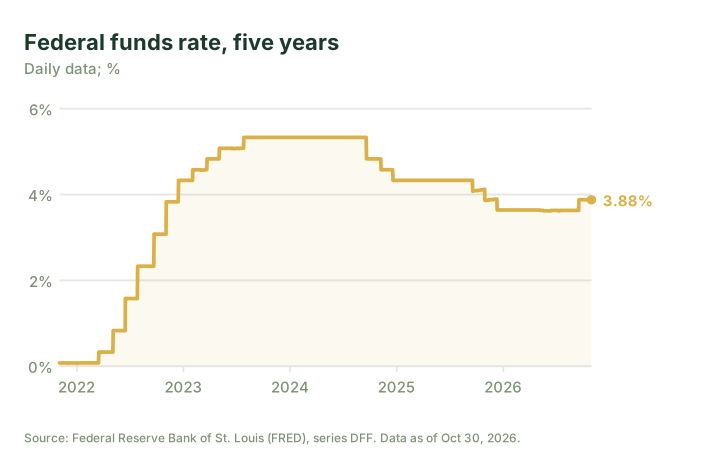
The effective federal funds rate shows the current hold in context of the broader rate cycle the Fed is navigating.
That hold followed the September meeting, when the Fed raised rates by 25 basis points (its first rate increase since 2023), bringing the target to its current 3.75%–4.00% range. Markets are taking the Fed's signaling seriously. Futures markets currently price in approximately an 85% probability of a rate hike at the December FOMC meeting. If that hike materializes, it would push the funds rate one step higher and set up more uncertainty heading into early 2027.
What We Are Watching in November
Several threads will shape November's markets. Incoming CPI and PCE readings are the most consequential data: the Fed has made clear that those inflation gauges will drive December's decision. Core PCE, the Fed's preferred measure, remains above target as of the latest reading, and any upside surprise would reinforce the case for another hike.
Earnings season winds down in early November. How large companies describe their AI capital spending plans and pricing power will matter more than headline beats or misses, especially after October's sharp reaction to Intel and Alphabet's guidance.
Treasury supply remains a mechanical force keeping upward pressure on yields. The federal government continues to issue substantial debt, and auction results in November will be watched for signs of weakening demand. Separately, as the December FOMC meeting approaches, clients who hold significant cash or are rolling short-term CDs should be paying close attention to how futures market odds shift on each incoming data release.
The broader takeaway from October: the economy remains resilient, corporate earnings outside AI-infrastructure spending are holding up reasonably well, and the Fed is moving carefully. That combination can keep markets in a choppy but not collapsing range. Concentration in a narrow set of technology and semiconductor names, however, remains a vulnerability worth examining in any diversified portfolio. October made that point with precision.
If you want to talk through how October's developments affect your specific plan (whether it's your bond allocation, your cash position, or your Roth conversion timing ahead of year-end), our team is happy to walk through it with you.
Common questions
Did the Fed raise rates in October 2026?
No. At its October 28, 2026 meeting, the Federal Reserve held the federal funds rate steady at 3.75%–4.00%. Two FOMC members dissented in favor of a quarter-point hike, and Chair Warsh noted inflation "remains elevated." The September 2026 meeting had delivered a 25-basis-point hike, the first since 2023, and futures markets currently price in roughly an 85% probability of another hike at the December meeting.
What happened to Treasury yields in October 2026?
Yields pulled back from their recent highs. The 10-year Treasury yield peaked at 5.31% on October 5, a multi-year high, before falling to 4.91% by October 30, a decline of 0.33 percentage points over the month. Short-term bills continue to offer competitive yields: the 12-month T-bill was at 4.42% as of October 29. Despite the October relief, rates remain historically elevated, and the path forward depends heavily on upcoming inflation data and Fed guidance.
Important Disclosures: This content for general educational purposes only. Securities are offered through LPL Financial, Member FINRA/SIPC. Advisory services are offered through Convergence Financial, an SEC-registered investment adviser; registration does not imply a certain level of skill or training. HomeBrook Wealth and Convergence Financial are separate entities from LPL Financial. This is not individualized investment, tax, or legal advice, or an offer to buy or sell any security, and may not suit every investor.
Information is as of the publication date and subject to change without notice. Opinions and forecasts, including third-party ones, are not guarantees. Data is from sources believed reliable but not guaranteed. Indexes are unmanaged, cannot be invested in directly, and do not represent client results. Examples are hypothetical and for illustration only. Investing involves risk, including loss of principal, and past performance does not guarantee future results. Bonds lose value as rates rise; small caps, commodities, and concentrated sectors can be more volatile. Convergence Financial does not provide tax or legal advice. Third-party links are provided for convenience only, and we are not responsible for their content.
Content in this material is for general information only and not intended to provide specific advice or recommendations for any individual. All performance referenced is historical and is no guarantee of future results. All indices are unmanaged and may not be invested into directly.
The economic forecasts set forth in this material may not develop as predicted and there can be no guarantee that strategies promoted will be successful.
There is no guarantee that a diversified portfolio will enhance overall returns or outperform a non-diversified portfolio. Diversification does not protect against market risk.
Stock investing includes risks, including fluctuating prices and loss of principal. Any company names noted herein are for educational purposes only and not an indication of trading intent or a solicitation of their products or services. LPL Financial doesn’t provide research on individual equities.
Government bonds and Treasury bills are guaranteed by the US government as to the timely payment of principal and interest and, if held to maturity, offer a fixed rate of return and fixed principal value.
Because of their narrow focus, investments concentrated in certain sectors or industries will be subject to greater volatility and specific risks compared with investing more broadly across many sectors, industries, and companies.